Remember Zefferelli's almost hallucinatory "Brother Sun Sister Moon?" There's another take out there now.
 St. Clare of Assisi, for eight hundred years regarded as the "little plant" who grew alongside the great mystic poet saint, Francis, is emerging as a towering figure in her own right, thanks to a burst of scholarly interest by medievalists and feminist historians. The wealthy girl who fled her father's house to work and pray alongside Francis and his friars, founded an order of religious women that continues to follow the first Rule written by a woman. From the period that produced the scholar and linguist Héloïse (of the tragic couple Héloïse and Abelard), and the theologian and visionary Hildegard von Bingen, Clare's writing and the disinterred oral testimonies of several who knew her in life are drawing attention to this woman who found a path to the divine through a life of voluntary poverty.
On May 10, Santa Clara University presented one of a growing number of symposia dedicated to the new work on Clare, headlined by Franciscan scholar Brother Bill Short, academic dean at the Franciscan School of Theology in Berkeley, with discussion and reflections by five other speakers before an audience of more than a hundred persons.
My small contribution, as spoken:
I have
been educated in the Ignation tradition, and I am a journalist -- in Central America I covered war, displaced people,
regional militaries. It is natural for me, as it might be for any of us, to look for
dimensions of the life of Clare, of the spiritual tradition she represents, in
the life of the world I know.
And she is present.
In some areas where I work, poverty is as extreme as you
will find in the world. Clare chose her
life of poverty, indeed had to struggle for it. Residents of Brazilian favelas
and the ungiving countryside of Chiapas do not choose their poverty.
But I have met many who do not despise it.
Instead, in Latin America are those who see
a pattern and purpose to their lives in reflection upon the very poverty in which they live, asking questions about what they might expect of a dignified life in this world. The faithful often ask questions rooted in the Gospel, which they have heard their
whole lives and in many cases study with each other, even those who cannot read,
dynamically making connections with their own lives.
In countless interviews, I have heard
ordinary Salvadorans, for instance, identify their station with that of Jesus,
much like Clare wrote to her dear friend Agnes of Prague, looking at "that
mirror suspended on the cross."
The very first story I reported in El Salvador was in the
capital where some two hundred peasant families fleeing the violence in the countryside camped with torn
blankets at a church on the floor of its patio. It was Advent.
A boy had drawn a picture of the creche in the stable, and written
underneath in a child's hand:
"Even the Baby Jesus had no house to be born in."
Over the years I realized the highest praise that could come
from the struggling people was to say of a particular bishop, or someone from
the outside, "Esta
con los pobres. He is with the
poor."
Franciscan scholar Regis Armstrong has written,
"Clare's experience of poverty taught her to open herself completely to
God, to come before God with increasing confidence."
In Central America, where 50,000 people died in tiny El
Salvador in the 1980s, 17,000 in Nicaragua -- most as a result of the Contra
war managed and funded by the United States -- and some 200,000 died or
disappeared in Guatemala, almost all unarmed civilians, it has been women,
sometimes indigenous, invariably poor, who have risen above stereotypes, and
led the post-war quests for justice and healing.
I have been to many exhumations, where the remains of those
massacred in numbers are disinterred from anonymous burial places, so they may
have proper burials, their names and very existence acknowledged by a wider
world. Almost always it has been
the women of the community who have faced authorities, brought in the forensic
scientists, to make sure these extraordinary processes take place.
Armstrong has said of Clare, "vulnerability leads to
strength." But who would choose to live on less than the minimum daily
caloric requirement as most Central Americans do? Or in one of several
countries where income is less than $1000 a year? If we are not poor, knowing
Clare might inspire us to being with the
poor, and learn from the poor of our own day.
As a reporter, I always wrote what is called the first draft
of history, getting a story as quickly as possible and putting it out. Now as an author on Latin America, I
feel I may be writing second drafts. I have also come to realize how much
history is a collection of stories,
of life stories. Some are so
outstanding, rich with valor and self-examination, they serve as models, like
that of Clare.
But they must be true.
The first draft of Clare's story, the medieval woman, the
"little plant" that grew near St. Francis, the Clare that we know
from her canonization decree written by churchmen, was not untrue.
However, recently we are seeing a burst of scholarship based
on Clare's own writing, and on oral testimony of many who knew her in life,
scholarship that is going deeper.
The moment could not be more timely, to shed light on the dynamic Claretian
spiritual tradition.
Witness the shocking and complex recent Vatican assessment
of American sisters, which begs the questions, not for the first time: What is the place of religious women,
or any women, in the Church which does not grant them the space, time, even a
few words of their own to dialogue on the priorities of their lives? To what extent do U.S. women religious (with their vow of
poverty) represent women in the Church?
Not as a journalist who has investigated this with
independent sources, but as a woman educated in
Catholic institutions who is a practicing Catholic, I have a hunch. I'll go out on a limb here, and suggest
that yes, the vision and priorities of our women religious is not unreflective
of those among Catholic women, and of men among our Catholic brothers.
I regard Clare as a saint for
a lifetime. As a young girl I was
enchanted by the other young girl from the far past with the -- let's face it
-- radical, unconventional behavior, a girl who followed her soul.
Now, much older, older than Clare was when she died, I am
most amazed and respectful of her consistency over a lifetime, her unwavering
position in the face of challenge, and in the face of vulnerability she might
have escaped at any moment of her choice.
Early on the morning of Nov. 17, 1989, I was among four
journalists first to arrive at the scene of the massacre in San Salvador of six
Jesuit priests, their cook and her daughter. Four bodies were on the grass of the priest's yard,
covered by white sheets. Fr. Jose Maria Tojeira, then Superior of the Central
American Jesuits, quickly took me to see the others who had died. When we returned to the bodies on the
grass, two photographer colleagues had arrived.
I said, "Father, you have to take off the sheets."
Something like alarm seemed to cross Tojera's features
but passed quickly. He said, "Promise me these photos get to the
Jesuits."
When the sheets were taken away and I saw the faces of those I had known in life, my first impression was not,
"They received the martyrdom they sought."
Instead, a thought came strong and clearly to me: "They
died because they were consistent, unwavering. "
Eight hundred years ago, Clare, our contemporary, wrote:
What you hold, may you always hold,
What you do may you do and not stop,
but with swift pace, light step, feet unswerving so that
even your steps stir up no dust, may you go forward, securely, swiftly and with joy.


 So what is Creative Nonfiction?

 Pink
Smoke Over the Vatican, filmmaker Jules Hart's compelling new documentary,
uncovers the history of women priests in the Catholic Church from its
beginnings, showing how an increasingly patriarchal
institution squeezed out women from formidable roles over the centuries. Churchmen wrote laws that said an
exclusively male priesthood was so central to doctrine that it was a given, a
rule that could not be broken. Nevertheless, some clear-eyed bishops have begun
again to ordain women, believing that the unmistakable interior call to the
priesthood, a vocation, is not restricted to one gender.
Pink
Smoke Over the Vatican, filmmaker Jules Hart's compelling new documentary,
uncovers the history of women priests in the Catholic Church from its
beginnings, showing how an increasingly patriarchal
institution squeezed out women from formidable roles over the centuries. Churchmen wrote laws that said an
exclusively male priesthood was so central to doctrine that it was a given, a
rule that could not be broken. Nevertheless, some clear-eyed bishops have begun
again to ordain women, believing that the unmistakable interior call to the
priesthood, a vocation, is not restricted to one gender.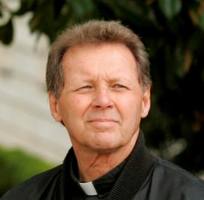 Fr. Roy Bougeois, awarded the Purple Heart for military service in Vietnam and a Maryknoll priest for almost forty years, is being excommunicated for his support of the women, the most severe punishment the Church can inflict.
 You
will learn from Pink Smoke and even laugh with it. No
matter what you bring to the movie from your own history, it's difficult not to
admire the women aspiring to ordination, to answering their call, and their Catholic brothers who
support them.
You
will learn from Pink Smoke and even laugh with it. No
matter what you bring to the movie from your own history, it's difficult not to
admire the women aspiring to ordination, to answering their call, and their Catholic brothers who
support them.


